New York City is one of the nation’s oldest and most prominent destinations for Black history and culture. Across the five boroughs, African American landmarks honor the stories of a people whose contributions to the City date back hundreds of years.
In Lower Manhattan on Duane Street, the African Burial Ground, a six-acre memorial, acknowledges the role slavery played in building this city. The plot is the largest unearthed burial ground in North America for both free and enslaved African descendants. Uptown, on 125th Street in Harlem, the legendary Apollo Theater still stands. The iconic hall has served as both launchpad and safe space for Black and brown musicians since 1934; the institution has recently expanded to include the newly opened Apollo Stages at The Victoria and its historic theater is undergoing an extensive renovation meant to be completed in 2026. Over the bridge in Crown Heights, Brooklyn, a plaque in Brower Park commemorates the life and achievements of Shirley Chisholm. In 1972, the equal rights icon became the first Black woman to make a bid for the US presidency. A year later in the Boogie Down Bronx, hip-hop was born. During a back-to-school bash, DJ Kool Herc experimented on the turntables and in turn created a musical and cultural movement that has challenged generational thinking around politics, race and language.
Black history is American history, yet Black historical sites are often omitted from this country’s record. According to the National Register of Historic Places—the federal government’s official list of locations worthy of preservation—only 2 percent of the 95,000 entries recognize the experiences of Black Americans.
In New York City, Black lives and Black stories matter. NYC is one of the most diverse cities in the world, and NYC has one of the largest populations of Black residents in America. Explore these distinguished points of interest that celebrate the contributions of the Black community to the City’s culture.
Museums and Educational Centers
Visit these for insight into Black history, art and music.
Caribbean Cultural Center African Diaspora Institute
120 E. 125th St., Harlem, Manhattan, cccadi.org
This multidisciplinary organization works to preserve the cultures of the global African diaspora. It does this through all kinds of programming, including exhibits, performances, educational offerings, artist talks and workshops. Their landmarked building has three art galleries and puts on events year-round. Artists who have appeared or been featured here include Dizzy Gillespie, Celia Cruz and A Tribe Called Quest.

Louis Armstrong House Museum. Photo: Kate Glicksberg
Louis Armstrong House Museum
34-56 107th St., Corona, Queens, louisarmstronghouse.org
Louis Armstrong was one of the most famous musicians in the world when he and his wife, Lucille, settled on their modest digs in the working-class neighborhood of Corona, Queens, in 1943. The house they resided in is now a historic site and interactive museum. The house museum is open for in-person tours, and the cultural center, which opened in 2023, serves as a base for performances and exhibits, such as Here to Stay—an overview of Armstrong's long career.
The Malcolm X and Dr. Betty Shabazz Memorial & Educational Center
3940 Broadway, Washington Heights, Manhattan, theshabazzcenter.org
This landmarked Washington Heights building has been a fixture in the community for decades. Today, 3940 Broadway is an educational and cultural center dedicated to the legacy of Malcolm X and Dr. Betty Shabazz. Back in the day, it was known as the Audubon Ballroom, a theater, dance hall and weekly meeting locale for the Organization of Afro-American Unity, founded by Malcolm X. It was here, too, that the activist was assassinated while giving a speech in 1965.
Museum of Contemporary African Diasporan Art
10 Lafayette Ave., Fort Greene, Brooklyn, mocada.org
MoCADA honors the African diaspora through visual and performing arts. For more than 20 years, the creative space has showcased influential works from artists like Jamel Shabazz and Wangechi Mutu, who explore themes relevant to Black communities in NYC and across the globe. MoCADA’s main gallery, the new L10 Culture Lab II, features multidisciplinary exhibits; seasonal extensions of the museum's mission include the Abolition House and Ubuntu Garden. See the website for details.
Sandy Ground Historical Society Museum
1538 Woodrow Rd., Rossville, Staten Island, sandyground.wordpress.com
Sandy Ground is the oldest occupied African American settlement in the country. Founded in the early 19th century by free Blacks from New York, Maryland and Delaware, the community was a significant stop on the Underground Railroad. Back then, Sandy Ground flourished by harvesting oysters and farming. Today, the neighborhood is home to 10 Black families who are descendants of the original settlers and a museum that preserves the area’s history through exhibitions, art, photography and cultural events. The museum is currently closed to visitation.

Schomburg Center for Research in Black Culture. Photo: Kris Grave
Schomburg Center for Research in Black Culture
515 Malcolm X Blvd., Harlem, Manhattan, nypl.org/locations/schomburg
In January 2017, Harlem’s Schomburg Center was officially declared a National Historic Landmark, but the public library has been preserving and protecting narratives from the Black experience for almost a century. Take advantage of the many ways to connect, shop and explore, whether in-person exhibitions, talks or using their online resources. The Schomburg Center turned 100 years old in 2025—visit their website for information on ongoing exhibitions and special events commemorating the milestone.

The Studio Museum in Harlem
144 W. 125th St., Harlem, Manhattan, studiomuseum.org
Like most Black cultural institutions, the Studio Museum was born out of necessity. In 1968, following the expansion of the landmark Civil Rights Act of 1964, a collective of local artists and activists wanted to provide a way to support other emerging artists of color and promote arts education. To celebrate their 50th anniversary, the museum broke ground on an 82,000-square-foot expansion, which took seven years to bring to fruition. The reimagined museum, which opened in November 2025, features a rooftop terrace, a welcome center and café, and increased indoor and outdoor space for exhibitions, performances, screenings and educational programs.
Weeksville Heritage Center
158 Buffalo Ave., Weeksville, Brooklyn, weeksvillesociety.org
Founded in 1838, just 11 years after New York abolished slavery, Weeksville was one of the first free Black communities in America. Back then, the progressive neighborhood was home to many of the City’s Black abolitionist leaders—it published its own newspaper that featured reading exercises and prayers. Today, the area’s historical significance is preserved via the Weeksville Heritage Center, a multidisciplinary museum that reimagines what life looked like for free Blacks in Brooklyn before the Civil War.
Monuments and Landmarks
A number of sites commemorate the lives of influential Black New Yorkers and of those once forgotten. Please note that some of these are private residences and are included as points of interest for reference, not as places that people can visit.

African Burial Ground National Monument. Photo: Gabby Jones
African Burial Ground National Monument
290 Broadway, Lower Manhattan, nps.gov/afbg
In Lower Manhattan on Duane Street, a six-acre memorial acknowledges the role slavery played in building New York City. The pristine plot is the largest unearthed burial ground in North America for both free and enslaved African descendants. In 1991, a construction crew discovered 419 graves while laying the foundation for a new federal building. Today, screenings, tours and talks are hosted on the sacred grounds; there are exhibits inside the visitor center.
Audre Lorde and Frances Clayton Residence
207 St. Paul’s Ave., Tompkinsville, Staten Island
Feminist, poet and internationally acclaimed civil rights activist Audre Lorde left Harlem in 1972 for this charming Staten Island abode. With its vast garden and proximity to the water, 207 St. Paul’s Avenue fulfilled both Lorde’s desire to be immersed in nature and her commitment to raise her children in NYC. She authored groundbreaking work (From a Land Where Other People Live, Coal and The Black Unicorn) while she lived here with her partner, Frances Clayton, until 1987. The NYC Landmarks Preservation Commission designated the house a landmark in 2019.
Frederick Douglass Memorial
W. 110th St. & Central Park West, Harlem, Manhattan
This monument at the northwest corner of Central Park honors the illustrious legacy of Frederick Douglass, an orator, writer and leader in the abolitionist movement, which fought to end slavery in America. The statue features a paving pattern influenced by traditional African American quilt designs amid historical details and notable quotes. It opened to the public in 2011.
Hunts Point Slave Burial Ground
Oak Point Ave. (bet. Hunts Point Ave. and Longfellow Ave.), the Bronx, hpsbg.weebly.com
In 2014, after discovering a black-and-white photograph captured at the turn of the 20th century, a group of teachers, students and historians uncovered a lost slave burial ground at Drake Park in the Bronx. On the front of the photo, deteriorating gravestones sit in a patch of grass; on the back, “Slave burying ground Hunts Point Road” is written in cursive. There are said to be 10 to 40 enslaved African descendants buried at this ancestral site.
Langston Hughes House
20 E. 127th St., Harlem, Manhattan
Author, poet, playwright and renowned social activist Langston Hughes was one of the most influential leaders of the Harlem Renaissance. For 20 years, Hughes resided at 20 E. 127th St., occupying the top floor of a three-story brownstone, where he penned I Wonder as I Wander, A Pictorial History of the Negro in America and Black Nativity—some of his most celebrated literary works. In 2019, his former home was one of 22 sites across the country awarded a National Trust for Historic Preservation grant through the African American Cultural Heritage Action Fund.

Marsha P. Johnson State Park. Photo: Jeanette Spicer
Marsha P. Johnson State Park
Kent Ave. bet. N. 7th & N. 12th Sts., Williamsburg, Brooklyn
Brooklyn's East River State Park has been dedicated to Marsha P. Johnson, memorializing the activist and transgender figure. Johnson was a trailblazer in the community—an inspiring leader, who, together with fellow activist Sylvia Rivera, advocated for homeless Black and brown LGBTQ+ youth who were rejected by their families, as well as those affected by HIV/AIDS.
Shirley Chisholm Circle
Kingston Ave. & Prospect Pl., Crown Heights, Brooklyn
At Brower Park in Crown Heights, a commemorative plaque acknowledges the life and achievements of Shirley Chisholm, a tireless champion for equal rights. In 1968, Chisholm became the first Black woman elected to Congress (representing New York’s 12th congressional district for seven terms), and in 1972, she was the first Black woman to make the bid for the US presidency. A proud Brooklynite, Chisholm remained dedicated to serving the community throughout her career. Farther east in the borough, bike-friendly Shirley Chisholm State Park also honors the pioneer.
Theater
These arts organizations and venues lead the way in NYC’s performing arts scene.

Alvin Ailey. Photo: Paul Kolnik
Alvin Ailey American Dance Theater
405 W. 55th St., Midtown West, Manhattan, alvinailey.org
A fixture in NYC since its founding in 1969, the Alvin Ailey American Dance Theater transcends racial and ethnic groups. Initially the company comprised young Black modern dancers and was known for classic masterpieces like Revelations, but as the company evolved so did its mission. Today, the Ailey School’s West 55th Street location unites patrons from across the globe through classes, programs and performances that preserve the uniqueness of the Black cultural experience. Watch this video to meet some of the dancers in the troupe.

Apollo Theater. Photo: Kate Glicksberg
Apollo Theater
253 W. 125th St., Harlem, Manhattan, apollotheater.org
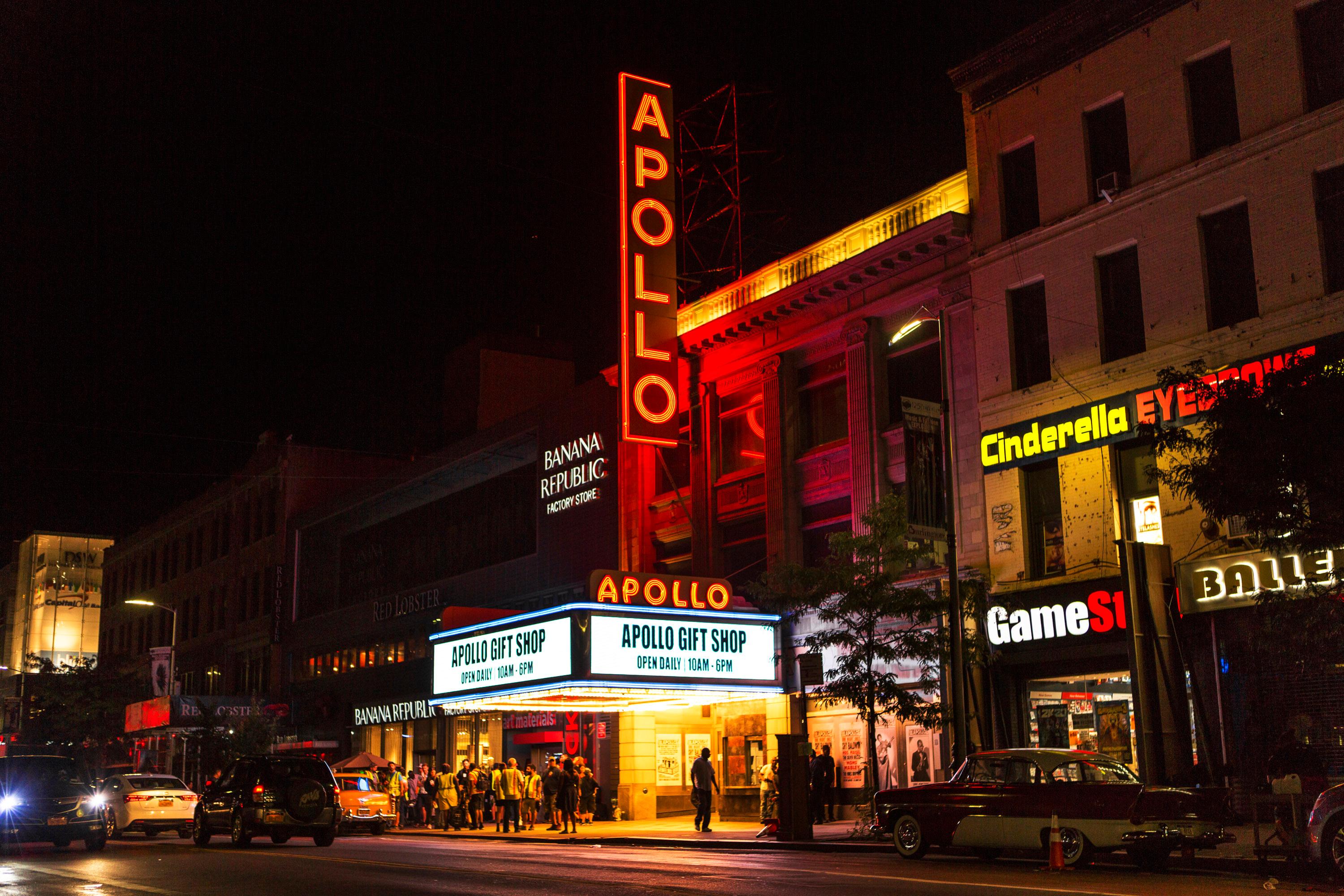
In 1914, when this venue first opened its doors as Hurtig & Seamon’s New (Burlesque) Theater, Black performers and patrons were banned. Twenty years later, the hall would become a safe space for some of the greatest Black musicians in American history. James Brown, Ella Fitzgerald, Billie Holiday and Sammy Davis Jr. all began their road to stardom on the famed Apollo stage. These days, the theater is undergoing a major renovation and closed for events. In the meanwhile, live concerts, exhibits and limited historic tours are taking place in a recently opened space, the Apollo Stages at The Victoria (233 W. 125th St.).
Black Spectrum Theatre
177-01 Baisley Blvd., Jamaica, Queens, blackspectrum.com
Located in a recreational complex within Queens’ Roy Wilkins Park, this 325-seat venue hosts stage productions, film screenings and other performing arts that bring awareness to issues at the forefront of African American, Caribbean American and African Latino communities. The venue’s commitment to inspiring the next generation of directors, performers and playwrights is evident through its enriching youth and after-school programs.
Harlem Stage
150 Convent Ave., Harlem, Manhattan, harlemstage.org
Harlem Stage is a cutting-edge performing arts center that supports artists and organizations, locally and globally, through its two venues: Aaron Davis Hall (a three-theater complex established in 1979) and the Gatehouse (an award-winning stage that opened in 2006). Countless creatives of color have left their mark on one or more of their visionary stages: Maya Angelou, Harry Belafonte, the Dance Theatre of Harlem and the Boys Choir of Harlem, to name a few.
National Black Theatre
2031 Fifth Ave., Harlem, Manhattan, nationalblacktheatre.org
With its mission to “produce transformational theatrical experiences that enhance the African American cultural identity by telling authentic stories of the Black experience,” the National Black Theatre has long been a Harlem mainstay. Established in 1968 by Dr. Barbara Ann Teer, the venue offers performances, lectures and a variety of classes that continue to advance the vision of its founder. The theater is undergoing an expansion that will see it move to a brand-new art complex spanning a fully city block on 125th Street. A soft opening is planned for 2026 with the inaugural season in the new space scheduled for 2027.